
Module 1: Introduction to Artificial Lift
Understanding the fundamentals and applications of artificial lift systems.
🎯 Learning Objectives
- Define artificial lift and when it’s required.
- Differentiate add-energy vs. reduce-density lift strategies.
- Recognize major AL methods used in the industry.
- Apply the outflow pressure relationship conceptually.
📘 Key Terms
Hydrostatic head
Outflow pressure (Po)
Friction losses (Pfr)
Wellhead pressure (Pwh)
Mixture density
📎 Prerequisite
No formal prerequisites. For deeper dives, continue to Module 2.
ℹ️ What & Why
Artificial lift is used when reservoir energy alone cannot sustain desired flow rates. Lift systems either add energy (e.g., pumps) or reduce effective fluid density (e.g., gas lift) to lower the hydrostatic column and improve outflow.
⚙️ Principles
Key Relation
Po = Ph + Pfr + Pwh
Outflow pressure equals hydrostatic head plus friction losses plus wellhead pressure.
💡
Tip
Reducing Ph (mixture density × true vertical depth) or Pfr improves flow without changing the reservoir.🧩 Methods Overview
- Sucker-rod (beam) pumping — most common mechanical lift.
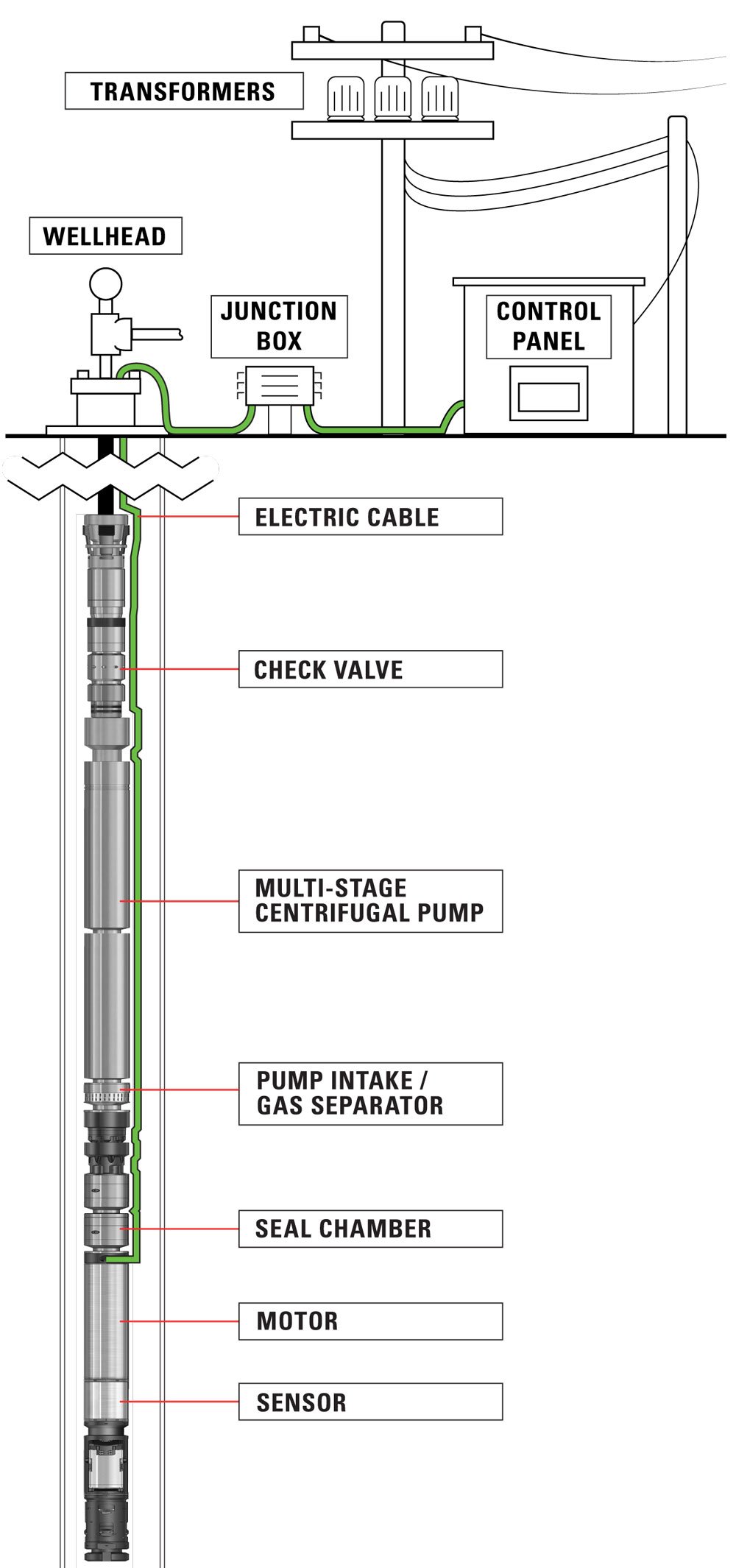
- Electrical Submersible Pumps (ESP) — high volume, deeper wells.
- Progressive Cavity Pumps (PCP) — viscous/solid-laden fluids.
- Gas Lift — reduces mixture density via injected gas.
- Plunger & Jet (hydraulic) lift — special applications.
🧪 Worked Example — Interpreting Po
Scenario: You measure Pwh and estimate Pfr. The well won’t flow. Which lever is most practical?
Concept: If you can’t lower Pwh (facility constraint), target Ph by reducing mixture density (gas lift) or adding energy (pump).
✅ Quick Knowledge Check
1) Why do we use artificial lift?
Correct — AL adds energy or lowers density to sustain flow.
2) Which method primarily reduces mixture density?
Gas lift injects gas to lower mixture density and hydrostatic head.
3) Spot the mistake:
Po = Pfr + PwhRight — include
Ph: Po = Ph + Pfr + Pwh.🧾 Summary & Takeaways
- AL is applied when reservoir energy is insufficient for target rates.
- Two strategies: add energy (pumps) or reduce density (gas lift).
- Po framework helps diagnose which lever to pull (Ph, Pfr, or Pwh).
- ESP, beam, PCP, and gas lift cover most operating envelopes.
➡️ What’s Next
Up next: Module 2 — Sucker-Rod Pumping Systems
Suggestion: skim your field’s AL mix and note which wells rely on density reduction vs. added energy.
Last updated: Aug 2025 • Author: Atlas ESP Academy